Quimbaya Gold (CSE: QIM; Frankfurt: K05; WKN: A3DT3C) has received independent confirmation for its Tahami Center project in the Segovia District (Antioquia, Colombia): Consulting economic geologist Dr. Stewart D. Redwood, who, according to the company, has specialized in porphyry copper systems in Latin America for more than 40 years, visited the area in November 2025 and confirmed a large-scale porphyry copper-gold-molybdenum system. This means that, in addition to the vein-bound gold targets already being pursued at Tahami South, a second, potentially independent target type is now coming into focus for Quimbaya Gold – including a concrete timetable for the first drilling in Q2 2026.
Quimbaya Gold Receives External Confirmation for Tahami Center
The focus of the announcement is the assessment by Dr. Redwood, who, after a site visit from November 6 to 8, 2025, classifies Tahami Center as a porphyry system. Quimbaya Gold estimates the currently mapped extent to be approximately 2.0 kilometers north-south and 1.4 kilometers east-west. Important from an exploration perspective: the system is “open in all directions,” meaning it has not yet been limited by natural or geological boundaries.
Quimbaya Gold emphasizes that this classification opens up a new perspective for the Segovia district. The area is historically known primarily for high-grade gold veins; the confirmation of a porphyry copper-gold-molybdenum system would – according to the presentation in the announcement – expand the metallogenetic picture of the region. Against this background, Dr. Redwood recommends accelerating exploration to define reliable drilling targets for the second quarter of 2026.
Classic “Textbook” Zoning and Multiple Chains of Evidence
The porphyry interpretation is based on several observations that Quimbaya Gold lists together with Redwood. A central point is the complete alteration zoning, which is considered a typical feature of porphyry systems: from the potassium-rich (potassic) core to a phyllic envelope and an advanced argillic lithocap. According to information from the field work, this zoning can be traced on the surface, which may indicate a well-preserved system.
In addition, the company mentions a complete sequence of porphyry vein types (including A/M/B and D types) and describes mineralized areas with visible sulfides, including chalcopyrite, chalcocite, pyrite and molybdenite. The picture is supplemented by geochemical evidence: Preliminary results from channel sampling showed “strongly anomalous” values for copper (Cu), gold (Au), molybdenum (Mo) and other elements such as lead and zinc.
Geophysics is mentioned as a further component: Quimbaya Gold refers to a strong positive magnetic anomaly that spatially coincides with the porphyry system. From the company’s point of view, the sum of these factors is several mutually supporting chains of evidence (mapping, alteration, mineralogy, geochemistry and geophysics) that justify the prioritization of the Tahami Center as an independent drilling target.
Two Target Types, a Timetable to the First Drilling in Q2 2026
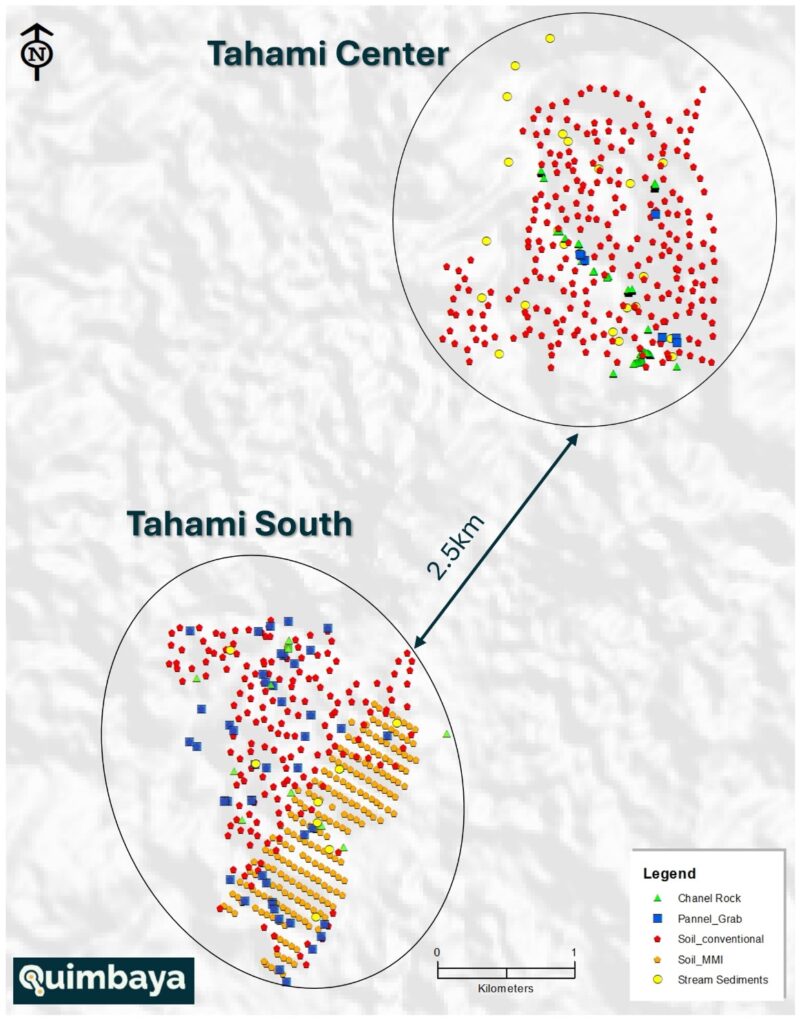
For Quimbaya Gold, the confirmation does not mean that other work will be postponed: The company expressly emphasizes a “Two-Target” strategy. Accordingly, the exploration of vein-bound mineralization at Tahami South continues, while Tahami Center is to be prepared for drilling as a porphyry target in parallel. Both areas are only about 2.5 kilometers apart and are located within the Tahami project’s land package of over 66,000 hectares.
Operationally, Quimbaya Gold outlines a clear process: Geochemical work including soil sampling and target definition is planned for Tahami Center in the first quarter of 2026; the first drilling is then scheduled to take place in the second quarter. At the same time, the company is planning geophysical work (magnetics and IP) for Tahami South in the first quarter and the start of a second drilling program in the second quarter of 2026. There are also some drill core analyses from Tahami South that should provide newsflow in the short term.