Aztec Minerals (TSX-V: AZT, OTCQB: AZZTF; WKN: A2DRF0) presents further promising results from the ongoing 2025/2026 drilling program on its Tombstone project in southeastern Arizona!
These are five additional reverse circulation (RC) drill holes from the historic Contention mine area, which, according to the company, significantly expand the known, near-surface, oxide gold and silver mineralization in the southern part of the project. The step-out drillings south of the previously defined “South Spoke” target now extend the mineralized zone along the strike to more than 1 kilometer in a north-south direction!
Tombstone is located approximately 100 kilometers southeast of Tucson and encompasses large parts of the historic Tombstone silver district. Aztec Minerals holds 85% in the joint venture. The current drilling focus is on a shallow-dipping, oxide gold and silver mineralization in and around the former Contention pit, which could potentially be suitable for a large-volume scenario. At the same time, a deeper target is being tested by means of core drilling, which could be related to the carbonate replacement (CRD) and skarn systems suspected in the district.
Aztec Minerals: Step-out drilling extends gold and silver zone to the south
The newly reported RC results come from the southern part of the Contention target and, according to Aztec, include broad sections of oxidized mineralization, some from the surface. The company highlights drill hole TR25-31: There, 44.1 meters averaging 1.161 g/t gold and 77.7 g/t silver were intersected, which corresponds to 158.97 g/t silver equivalent (AgEq). Within this section is a higher-grade partial interval of 3.0 meters with 7.504 g/t gold and 465.5 g/t silver (converted 990.78 g/t AgEq).
Aztec also describes drill holes TR25-27 and TR25-28 as important extension drillings. TR25-27 reportedly encountered two mineralized zones: 51.7 meters from the surface with 0.427 g/t gold and 42.87 g/t silver (72.74 g/t AgEq) and another 24.3 meters to the endpoint with 0.332 g/t gold and 85.94 g/t silver (109.15 g/t AgEq). TR25-28 in turn reports Aztec with 62.3 meters from the surface (0.18 g/t gold and 28.69 g/t silver; 41.26 g/t AgEq) and a second, smaller section deeper in the hole.
The company emphasizes that all five reported RC drillings intersected gold-silver mineralization and expanded the southern Contention target zone to the west, south and at depth.
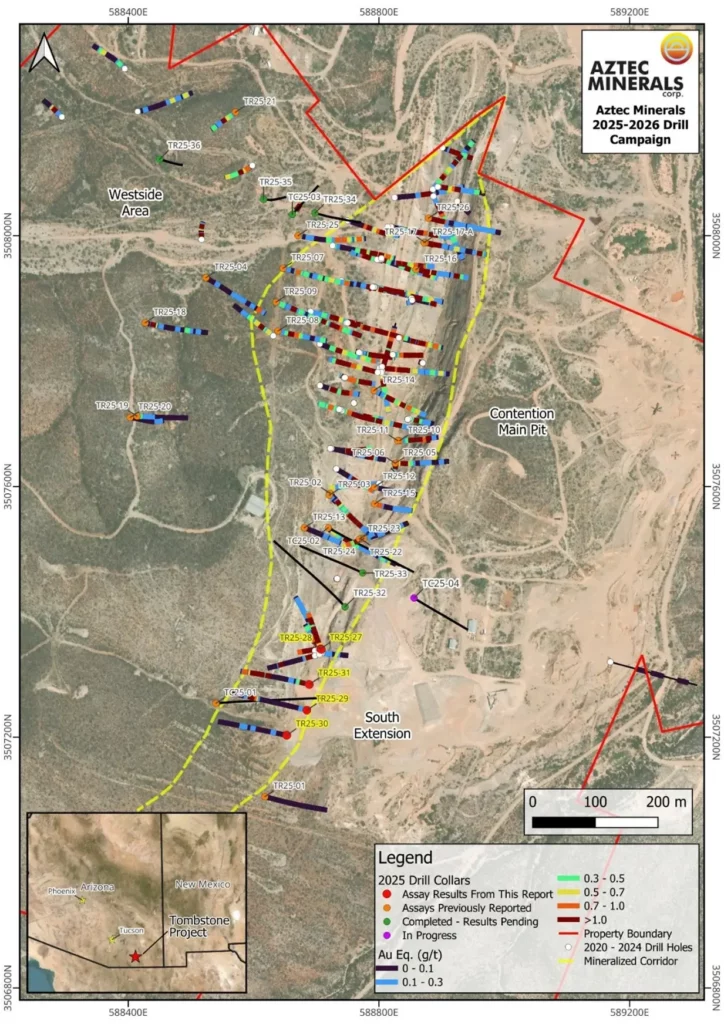
Drilling program 2025/2026: Many RC holes, further results pending
With the data now published, the database of the ongoing program continues to grow: Aztec states that 48 combined RC and core drillings have been completed as part of the campaign. In the RC part of the program alone, 45 drill holes were drilled; 15 RC holes are still “pending”, i.e. still without published analysis results. In addition to the southern extension targets, the company also mentions step-outs towards a western extension of the North Contention Zone as well as initial exploration approaches in the Westside Area.
Geologically, Aztec describes in the Contention area a picture of widespread oxidized and hematite-rich, silicified hydrothermal breccias, in which fragments of porphyry dikes and clastic sediments of the Bisbee Group occur – material that, according to the company, is typical of the historically mined ore of the Contention mine.
For classification, Aztec also refers to the history of the district: Between 1878 and 1939, the former silver production in the Tombstone district is estimated at around 32 million ounces of silver and about 250,000 ounces of gold. These historical figures provide the regional context, but do not replace the project-related assessment of the target areas drilled today.
Core drilling TC25-04: Testing a large anomaly at depth
Parallel to the RC drillings, Aztec Minerals is pushing ahead with the core drilling part of the program. Drill hole TC25-04 targets a large, southern NSAMT (Natural Source Audio-frequency Magneto-tellurics) target and was at the time of the announcement at 714.3 meters depth within the upper part of the anomaly. With increasing depth, hydrothermal breccias, skarn and occasional “B-type” porphyry veinlets had been observed more frequently. Aztec has already sent the RC section of the drilling (91 meters) to the laboratory for geochemical analysis.
Aztec Minerals describes the deep drilling as a test of a conductive body below the historic district, with the drilling progressing through hornfelsic and quartzitic units of the Lower Cretaceous Bisbee Formation and moving towards thick Paleozoic carbonate rocks below. The company is linking this work to its 3D geology and underground modeling, which should help identify potential extensions of the Contention system.
With the expansion of the oxide gold and silver zone in the south to over 1 kilometer strike length and the parallel deep tests, Aztec is thus continuing work on the Tombstone project on two levels: shallow, broad RC steps to delineate the oxide mineralization and deeper core drillings to verify large-volume geophysical targets. We are excited about the further results.