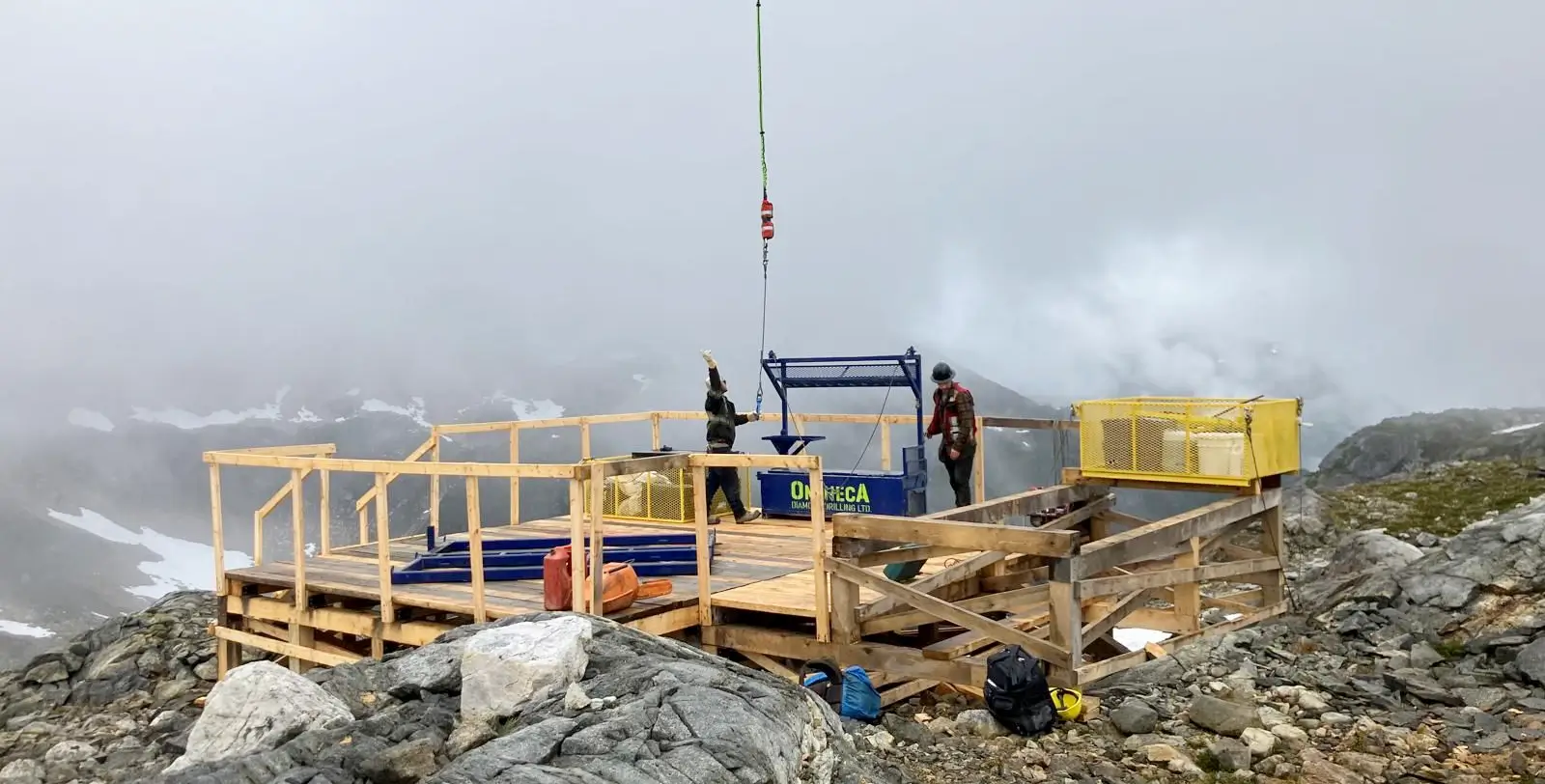

Juggernaut Exploration Ltd. (TSX-V: JUGR, FSE: 4JE) has received a five-year drill permit from the authorities in British Columbia for the 100% controlled Big-One Gold Project in the Golden Triangle. This permit is valid until March 31, 2031, and lays the groundwork for an initial, already funded drilling program that Juggernaut has planned for the coming year. The company then intends to systematically explore several gold-rich veins in the newly described, district-wide Eldorado System and the Gold Swarm discovery for the first time at depth.
Juggernaut Exploration Receives Drill Permit for Big one until 2031
With the drill permit now in hand, Juggernaut Exploration has planning certainty for the coming years. The permit covers the entire Big One area and allows for an advanced exploration program, including drilling. The project site is located in northern British Columbia, in a region known for large gold, silver, and copper deposits. The property can be accessed year-round by helicopter – including from the Glenora/Telegraph Creek Road near the Barrington Mine, as well as via the Galore Creek Road, which approaches within approximately 15 kilometers of the Big One property.
Additionally, infrastructure is being progressively improved: The Canadian government is providing CAD 20 million for the expansion and upgrade of the Galore Creek Road. The Big One property is also located only about two kilometers west of the Scud River airstrip, which was already used in the early stages of the neighboring Galore Creek development. Furthermore, exploration at Big One qualifies for the “Critical Mineral Exploration Tax Credit” (CMETC), a tax incentive for projects in the raw materials sector.
The project is situated in an environment with several known deposits, including the Galore Creek and Shaft Creek porphyry systems, the large-scale KSM Gold Project, the high-grade epithermal Brucejack Gold Mine, and other structurally controlled gold-silver zones such as Trophy and Sphal Creek. According to Juggernaut Exploration, the geology of Big One exhibits characteristics associated with such systems – including extensive propylitic alteration, porphyry-type mineralization, and distinct geochemical anomalies.
Eldorado System and Gold Swarm: High-Grade Surface Discoveries
Central to Juggernaut Exploration’s planned drilling is the Eldorado System, an area of approximately 22 km² that remains open in all directions. To date, more than 400 mineralized veins have been mapped there, up to 10 meters thick and located within shear zones up to 50 meters wide. These structures outcrop over more than one kilometer of vertical relief and can be traced on the surface for distances of sometimes more than 500 meters.
Within the Eldorado System, several zones have been delineated. In the Gold Dome Zone, outcrop samples (“Grab Samples”) yielded up to 263.70 g/t gold equivalent (AuEq), consisting of 256.60 g/t
South of this, another significant surface discovery was made with Gold Swarm. This area currently covers approximately 3 km² and hosts more than 100 gold-rich, polymetallic veins with thicknesses of up to 4.5 meters. They can be traced on the surface for more than 200 meters and show a vertical relief difference of up to 700 meters. The highest reported grades from Gold Swarm are 231.81 g/t AuEq (226.94 g/t gold, 335.00 g/t silver, as well as lead and zinc).

Extensive rock samples were taken at Big One in 2024 and 2025. In the Eldorado System, 41% of samples (219 out of 527) showed more than 1 g/t AuEq; in the Gold Swarm Zone, it was 65% (28 out of 43 samples). Maximum values across the entire project amounted to up to 256.60 g/t gold, 2,810 g/t silver, and 14.40% copper. These are predominantly selective outcrop samples, documenting high grades along visible structures and thus providing indications of the veins’ potential, without yet being comprehensively representative.
Structural Model, Drill Targets, and Next Steps for Juggernaut Exploration
In parallel with the sampling, Juggernaut Exploration has developed a detailed geological and structural model for Big One. Along an approximately 15-kilometer-long section, which the company refers to as the “Highway of Gold” corridor, common orientations, similar geochemical signatures, and recurring textures of the gold-mineralized veins have been identified. These observations suggest that the gold mineralization distributed across the area is part of a coherent, district-wide system that, as of now, remains open in all directions.
The polymetallic veins, the type of alteration, characteristic trace elements, and geophysical anomalies are interpreted by Juggernaut Exploration as indications of a common, deep-seated magmatic source – such as a gold-silver-copper-rich porphyry system or related intrusions from which the near-surface veins were fed. To test this hypothesis, the planned drilling aims to characterize the system in the third dimension for the first time and more precisely define the geometry of the large shear zones and veins.
Modern surveying and modeling techniques were employed in preparation for the drilling campaign. A high-resolution UAV photogrammetry flight over 52 km² in the Eldorado System and Gold Swarm Zone areas provides detailed orthophotos and terrain models. Additionally, a LiDAR survey was conducted over the entire 385 km² concession area. These datasets support 3D modeling and help to strategically place drill holes to optimally target the suspected high-grade structures.
CEO Dan Stuart emphasizes that with the receipt of the drill permit, all essential regulatory requirements are in place to systematically test the “Big One” trend through drilling starting in 2026. At the same time, Juggernaut Exploration highlights its collaboration with the Tahltan First Nation and other local stakeholders. The company aims to advance exploration in coordination with communities and authorities, taking into account long-term value creation and regional priorities.
Conclusion: With the now secured five-year permit, a comprehensive geological data package, and several defined drill targets, Juggernaut Exploration is setting the stage for the next chapter at Big One in the Golden Triangle. The results of the planned initial drilling will show the extent to which the gold-rich veins mapped on the surface continue at depth and how the district potential of the system can be further classified.