Silver and copper explorer Prismo Metals (WKN A2QEGD / CSE PRIZ) reports initial, promising results from ongoing exploration work at the Silver King mine. The company, led by CEO Alain Lambert, announces the discovery of two previously undescribed veins whose mineralogical properties resemble those of the historic Silver King deposit!
Preliminary measurements with a portable XRF device, according to Prismo, show mineralization with lead, silver, copper, and zinc, and an initial batch of samples has already been delivered to the lab. Initial results are expected in the coming weeks!
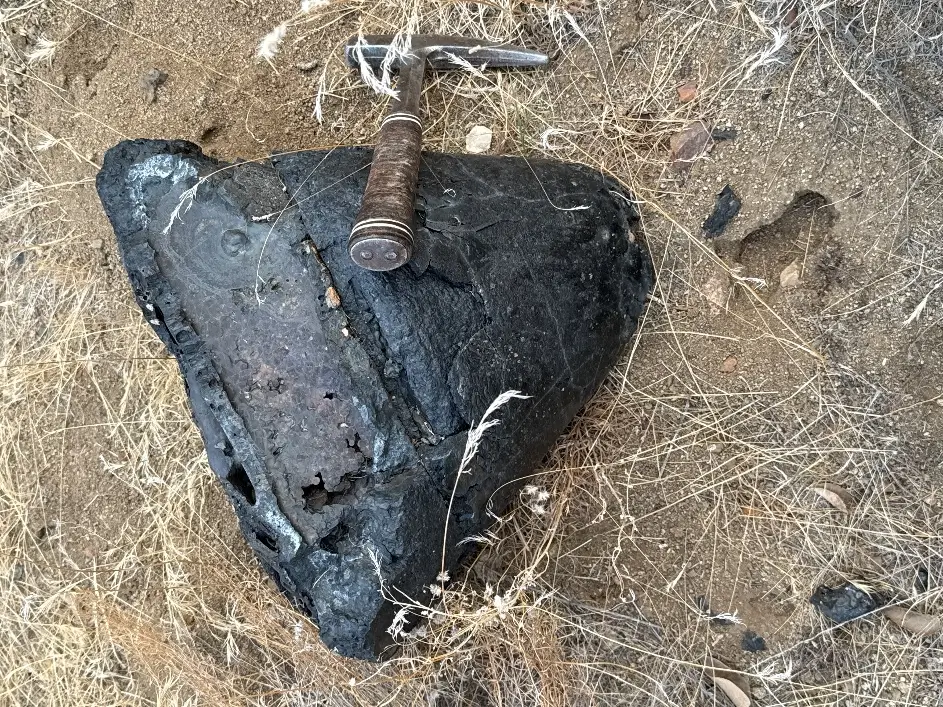
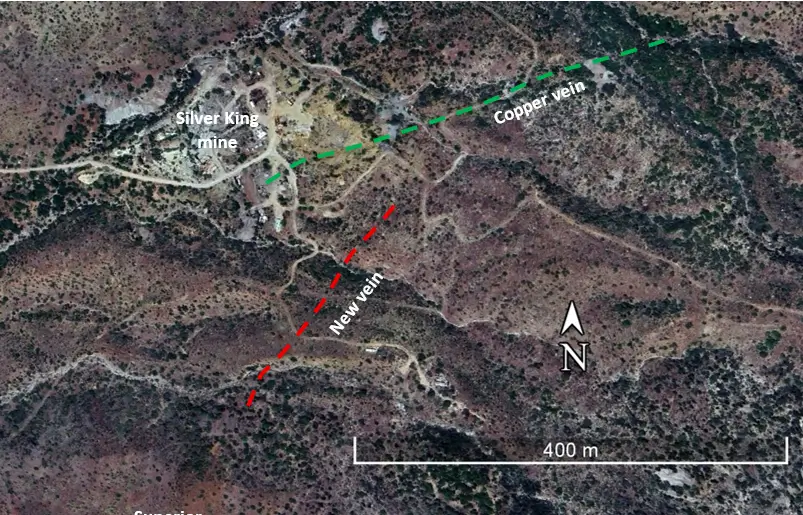
Particularly noteworthy: One of the new veins is located in a large dump approximately 300 meters south of the Silver King mine shaft. Numerous conical slag pieces with blunt ends were found there from an area used for smelting sulfide ore – an indication of historical production. Along the strike, several veins and prospecting pits can be traced for another 300 meters in a northeasterly direction, close to the Silver King Glory Hole. This marks the first time mineralization similar to the Silver King deposit has been observed outside the historic mine. An examination of a collapsed mine entrance confirmed quartz veins with sulfide minerals, primarily sphalerite, galena, and tetrahedrite.
Program, Permits, and Strategic Framework
At the outset of the project, the team systematically mapped historical mines and prospecting areas, and conducted geochemical and alteration mineral surveys around the surface expression of Silver King and other occurrences. Silver King is located just a few kilometers from Resolution Copper, the joint venture between Rio Tinto and BHP, as well as the high-grade, formerly producing Magma Mine. The Silver King mineralization is located within the same rock sequence as Resolution Copper, but here it is exposed at the surface and not covered by the thick volcanic sequence that overlies Resolution Copper.
Operationally, Prismo plans to complete the current exploration program as early as September and to start a preliminary exploration drilling program as soon as drilling permits are received. A corresponding operating plan has already been submitted to the Forest Service. In parallel, controls on mineralization in the historic mine are being further defined; access to historical workings on the 114th level is expected shortly.
Following a site visit in early August, Prismo President Gordon Aldcorn described the acquisition of this formerly producing, virtually un-modernly explored mine, in close proximity to world-class deposits, as a rare opportunity for Prismo Metals. The company had already reported on July 4, 2025, an option agreement to acquire 100% interest in the Silver King and Ripsey mines, located in Arizona’s prolific copper belt – near Prismo’s main Hot Breccia project. A team led by Chief Exploration Officer Dr. Craig Gibson has been on site since August 4.
History, Location, and Geology as Leverage for Prismo Metals
Discovered in 1875, the Silver King Mine is one of Arizona’s most significant historical production sites, yielding nearly 6 million ounces of silver with grades of up to 61 ounces per ton. Selected samples from small-scale production in the late 1990s showed historical grades of up to 644 ounces/ton silver (18,250 g/t) and 0.53 ounces/ton gold (15 g/t). The occurrence of freibergite (AgCuSbS) also indicates potential for antimony.
The mine is located just 3 km from the main shaft of the Resolution Copper project and is completely surrounded by Resolution Copper’s claim block – a clear location advantage. In near-surface mining areas, up to 10,000 ounces of silver per ton were reported; underground production until 1889 totaled nearly 6 million ounces of silver with grades between 61 and 21 ounces per ton. In a second phase from 1918 to 1928, an additional 230,000 ounces with 18.7 ounces per ton were added; since 1928, there has been no significant production.
Geologically, it is a steeply west-dipping, pipe-like stockwork and breccia zone, which was mined on eight levels to a depth of approximately 300 meters below a so-called ‘Glory Hole’ at the surface. The zone is described as a dense stockwork with local breccia zones and a quartz core content; due to mineralogical variations, a large part of the upper section remained unmined. The current owners rehabilitated the main shaft in the late 1990s, opened the upper levels, and extracted a small tonnage. Assay certificates from that period show selected samples with 400 to 600 ounces of silver per ton, 0.2 to 0.5 ounces of gold per ton, and some base metals. Modern exploration work has practically not taken place to date – accordingly, Prismo is convinced that the exploration potential to be demonstrated at several drill targets is significant.