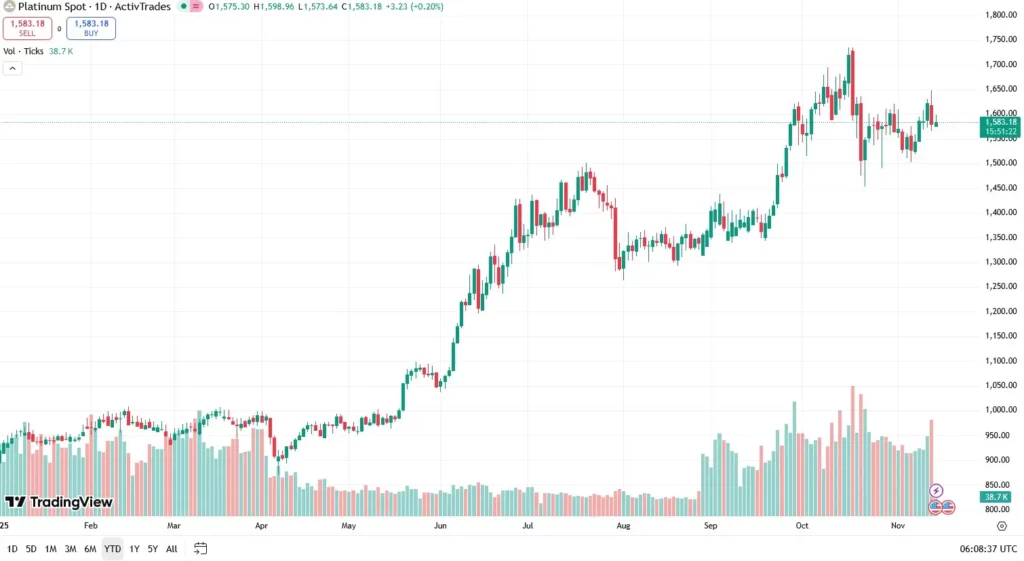
The price for one troy ounce of platinum is once again above $1,600. The price has not only reached a 3-week high, but also gives reason to expect that the correction that started in October may already be over. However, this assumption is no more than a working hypothesis for traders and investors, because the path for further price increases will only be clear once the high of $1,731.7 reached in mid-October is reached again and sustainably overcome.
However, the chances for this are good, because platinum, which is naturally one of the rarest and therefore most precious metals, is still in deficit. Demand from industry is high and, triggered by the massive price increase of around 70 percent since the beginning of January, more and more investors are also becoming aware of the precious metal.
In normal years, investor demand plays only a subordinate role in the platinum market. The demand from industry is absolutely dominant. It uses platinum primarily as a catalyst. This occurs both in exhaust gas purification in cars and in the chemical industry when it comes to accelerating desired reactions.
South Africa holds the reins in the platinum market
As with other raw materials, platinum production is dominated by one country. However, this is not China, but South Africa, as the republic accounts for around 80 percent of world production. Producing in South Africa, however, is a challenge for the corporations. The mines are very productive but also very deep, the workforce is highly willing to strike, and the trade unions are a powerful factor in the country.
In addition, the power supply cannot fully cover the steadily growing electricity demand in the country. Power outages are therefore the order of the day and repeatedly affect mine production. This mix of challenges is spiced up with a government policy that is anything but positive towards mining in the country, especially when it is operated by Western companies.
The strong price increase of 70 percent this year does heal some wounds that have been inflicted in recent months, but on the other hand it also awakens new desires among politicians and the workforce. Not so long ago, the prices that could be achieved for platinum were only just above or even below the cost of production.
Platinum is primarily an industrial metal today
Such challenges are existential for every mining company. It is about bare survival and no matter which raw material is mined and no matter how quickly and how high the prices subsequently rise, such a situation has a long-lasting effect. No mine manager wants to prematurely rely on a new boom and then be caught cold by prices that collapse again.
Therefore, no one should be surprised if, even after a price increase of 70 percent, platinum production does not increase or only increases very hesitantly. Mine production is not a tap that can be turned on and off quickly. The image of a cumbersome tanker on the high seas with a large turning circle and five kilometers of braking distance is much more fitting.
Many investors tend to overlook these points. This inevitably leads to disappointments, which are repeatedly reflected in sharp price reactions. Currently, however, the factors mentioned speak more in favor of those investors who continue to bet on rising prices, because it will take some time before the mining companies react to the increased prices with an increasing platinum production.
Is platinum slipping into a new, additional role?
In this context, it is interesting to note that the recent resurgence of the platinum price above the $1,600 per troy ounce mark has also been linked by analysts to general macroeconomic events. The general economic weakness that is emerging in the USA has also been cited as a reason for investors increasingly looking for a safe haven for their money and also taking a look at platinum as a very rare precious metal.
The next interest rate cut by the US Federal Reserve expected for December is also mentioned as a price driver. Similar to gold and silver, the aspect of inflation protection would become increasingly important for platinum. Whether this is actually the case and whether this development is permanent remains to be seen in the coming months. But even if investors should not permanently discover platinum as inflation protection for themselves, the structural deficit remains due to the high demand from industry with only slightly increasing production from the mines.
It is likely to remain the decisive factor in the coming months and, until further notice, speaks more in favor of rising than falling platinum prices. The market will send a clear signal for an immediate continuation of the rally if the price of an ounce of platinum reclaims the high of $1,731.7 reached in October 2025 and then significantly overcomes it after a brief consolidation.