
Lake Victoria Gold (TSXV: LVG / FSE: E1K) has announced the completion of its latest drill program at the fully permitted Imwelo Gold Project in northern Tanzania. According to the company, all assay results from the campaign are now available. The focus was on “Area C,” which is to be systematically advanced with a view to construction preparation and a short-term production start.
Lake Victoria accordingly speaks of a significant milestone, as the program has both confirmed the mineralization below the current open-pit design and delineated new extensions west and east of the planned pit!
For Lake Victoria, one point in particular comes to the fore: the results are intended to support the existing geological interpretation and at the same time provide the basis for making the final pit optimization and further development planning more robust. The company also emphasizes that the necessary permits are already in place and several technical work programs have now been completed or are being evaluated.
Lake Victoria’s Success in Imwelo Area C: Continuity at Depth and New Lateral Extensions
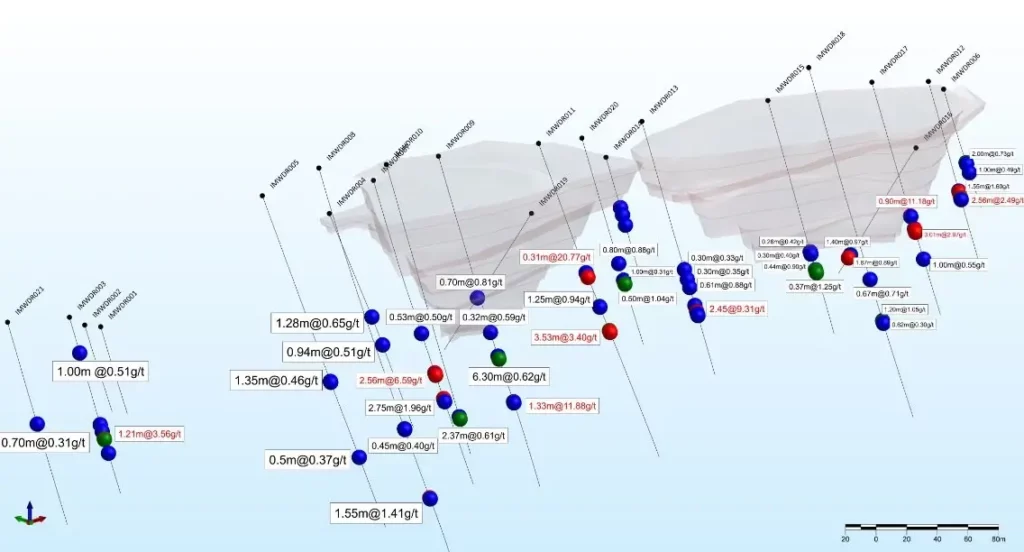
The core of today’s announcement is the statement that drilling has confirmed mineralization down-dip along the entire pit design. Lake Victoria Gold highlights that geological continuity has now been proven to a vertical depth of more than 250 meters – compared to historical model limits of around 200 meters. At the same time, the program has defined new mineralized zones east and west of the previous pit boundaries. For the east side, the company explicitly names drill hole IMWDR018 as confirmation of mineralization outside the current eastern pit boundary. On the west side, according to the announcement, additional mineralized areas were intersected beyond an interpreted north-northeast-striking structure (dyke/fault), thereby opening up a new field for potential resource growth!
The reported intercepts are from diamond drilling (NQ core) and partly RC drilling. Selected highlights include IMWDR007 with 6.96 g/t gold over 2.56 meters (including 65.02 g/t over 0.25 meters) and IMWDR009 with 11.88 g/t gold over 1.33 meters (including 68.74 g/t over 0.22 meters). Further examples are IMWDR013 with 9.31 g/t over 2.45 meters (including 21.65 g/t over 0.96 meters) and IMWDR017 with 11.19 g/t over 0.90 meters (including 32.84 g/t over 0.30 meters), plus an additional 2.97 g/t over 3.01 meters in a deeper interval.
From the company’s perspective, these data not only underscore the continuation of mineralization at depth but also the potential to define additional ounces both within and outside the current design – for example, through mineralized zones in the footwall and hanging wall outside the main vein.
CEO Marc Cernovitch emphasizes that technical data are now available that are required for final pit design, resource conversion, and mine planning. Exploration Manager Hendrik Meiring adds that the geology provides the expected picture: mineralization, alteration, and structural continuity are consistent across multiple zones – including at depths beyond 250 meters below the surface.
Technical Building Blocks for Pit Optimization and Construction Preparation
However, Lake Victoria does not present the program as a pure exploration drilling campaign, but as a work package with multiple objectives along the development chain. A central point is resource certainty: according to the company, the results reflect thicknesses and grades that support the existing historical resource model. This improves confidence in possible upgrades of resource categories – particularly from “Inferred” to “Indicated” and prospectively also a stronger “Measured” classification.
In parallel, two geotechnical drill holes were completed. The oriented core material serves for detailed recording and characterization of the rock mass. Lake Victoria intends to use these data to refine slope angles, support measures, and ramp geometry – precisely those parameters that are crucial for final pit optimization and risk management in open-pit mining.
In addition, preparatory work for operational start-up is underway: shallower drilling is intended to support grade control planning, particularly with regard to preparatory waste stripping and the establishment of an ore stockpile before production begins. Furthermore, representative samples from oxidized, transitional, and fresh material were selected for confirmatory metallurgical tests. According to the announcement, the goal is to validate recovery rates for each material type and draw conclusions for early mining and process optimization.
At the same time, the announcement contains a clear note: although JORC-compliant PEA, PFS, and updated PFS work exists, these should not be considered current in the sense of the Canadian standard NI 43-101. Lake Victoria has not yet submitted its own feasibility study that proves mineral reserves (as opposed to resources) and thus definitively demonstrates economic viability and technical feasibility. Accordingly, any decision towards production start-up is associated with increased uncertainty.
Ultimately, with the completion of the Imwelo Area C program, Lake Victoria Gold demonstrates that the project is moving from definition to implementation: with proven extensions of the mineralized system, geotechnical assurance for pit optimization, and preparatory work for grade control and metallurgy.