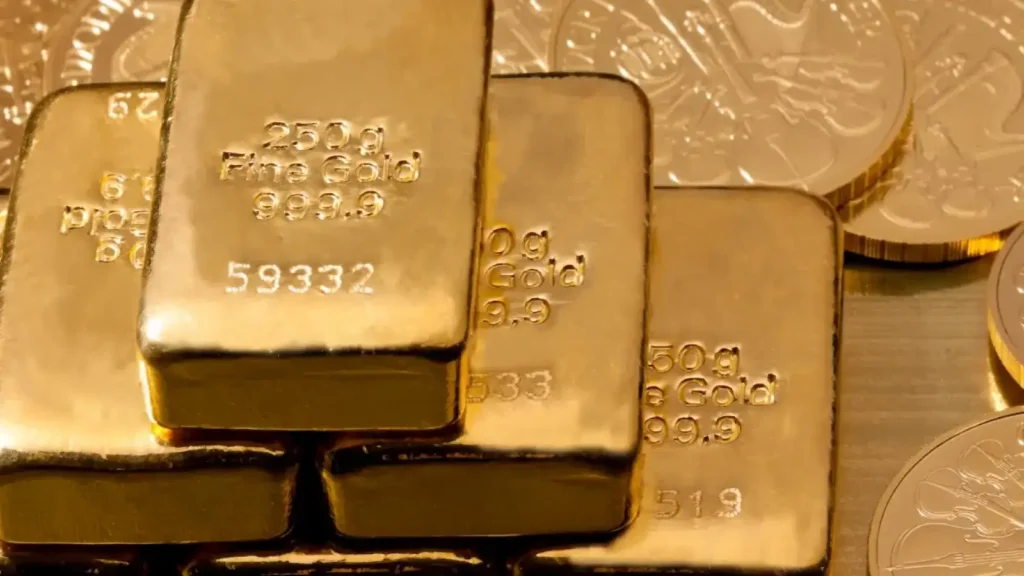

In JP Morgan’s assessment, the gold price could exceed the $5,000 USD per troy ounce threshold as early as next year. By the end of 2026, the institution projects a potential range of $5,200 to $5,300 USD. The asset manager identifies ongoing central bank purchases, particularly from emerging markets, as a key driver. This demand has significantly influenced the upward trend of recent years and is expected to continue impacting the market – even if buying momentum might temporarily slow down due to increased prices.
Central Banks as a Supporting Pillar for Gold
Gold still plays a comparatively minor role in the foreign exchange reserves of many central banks – particularly in Emerging Markets. This, according to JP Morgan, is precisely an argument for additional allocations: several countries are gradually increasing their share of the precious metal to diversify reserves and reduce dependence on US-centric financial structures. According to industry data, 634 tons of gold were added to state treasuries in the twelve months leading up to September. For the full year 2025, a range of 750 to 900 tons of net purchases is projected. Recent drivers of this trend have primarily been China, along with countries such as Poland, Turkey, and Kazakhstan.
The reasons behind these movements include, on the one hand, growing budget surpluses in certain emerging markets that require reinvestment. On the other hand, gold remains a tool for monetary authorities to hedge against currency and credit risks. JP Morgan emphasizes that the US dollar is not being “replaced”; rather, it concerns a gradual shift where a larger share of future funds is allocated to gold. In sum, this creates a steady, structural demand pillar that supports the gold market even during phases of weaker investment inflows.
Gold: from Record High to Consolidation
The gold price (XAU/USD) had marked a new record level above $4,380 USD per ounce at the end of October, before profit-taking ensued in the following weeks. Since its peak on October 29, the price is approximately 6% lower, but remains significantly positive year-to-date – the precious metal has seen an increase of more than 50% this year. Analysts at JP Morgan Private Bank categorize the recent correction as part of a dynamic but intact upward trend, whose foundation has broadened: alongside central banks, gold remains a sought-after asset as a “safe haven” amidst uncertainties concerning public finances, currencies, and the economy.
The levels outlined by JP Morgan – over $5,000 USD next year and $5,200 to $5,300 USD by the end of 2026 – are among the more optimistic scenarios in the market, yet they fall within the range of other institutions. Other banks also consider a continuation of the upward trend possible, projecting prices near the $5,000 mark by 2026. The breadth of these forecasts highlights gold’s sensitivity to macroeconomic variables – from real interest rates and exchange rates to geopolitical risk premiums.
Investors and Foreign Exchange Reserves: why more Funds could Flow into Gold
Beyond central banks, the positioning of institutional and private investors is gaining attention. According to JP Morgan’s assessment, gold’s share in many portfolios remains modest despite recent months’ increases. Even a moderate rise – for instance, if more investors strategically hold up to around five percent in gold – could generate significant additional demand. This thesis is supported by two developments: first, the pursuit of diversification in a market environment where equity and bond prices are at times positively correlated; second, ongoing discussions about the intrinsic value of fiat currencies and the role of real assets as a counterbalance.
For gold, this implies a broadening demand base. On one hand, regular central bank purchases ensure a stable underlying demand for physical metal. On the other hand, ETF inflows, futures market positioning on exchanges like COMEX, and retail segment purchases can either accelerate or decelerate price formation in the short term. In sum, this creates an interplay of structural demand and tactical movements that could pave the way for higher levels – without guaranteeing a linear progression.
Several variables remain crucial for the future development of the gold price. These include the direction of US real interest rates, the US dollar’s exchange rate performance, global inflation dynamics, as well as fiscal and geopolitical factors. Historically, falling real yields or intensifying currency and budget debates strengthen gold’s appeal. Conversely, an environment of rising real interest rates, a stronger dollar, or a normalization of geopolitical risks can dampen the tailwinds.
Regardless of short-term fluctuations, gold has increasingly become a central focus of institutional allocation decisions in recent years – a trend that, according to JP Morgan, could continue. The combination of central bank purchases, potentially higher portfolio allocations, and the precious metal’s role as a reserve and diversification component provides the narrative underpinning the aforementioned price targets.