1. Review
After the Bitcoin price had been moving sideways above USD 108,000 since the beginning of July, still bullish, but with strong fluctuations, it reached a minimally higher all-time high again on October 6 at USD 126,272. Immediately afterwards, however, there was a significant decline to USD 103,530, from which Bitcoin was only able to recover to USD 116,381.
Since October 27, however, the selling pressure has become increasingly strong, so that Bitcoin fell to its lowest level in around seven months on Tuesday at USD 89,189. In an initial reaction, Bitcoin can recover by around 5% in the course of the day and is currently trading at around USD 93,500.
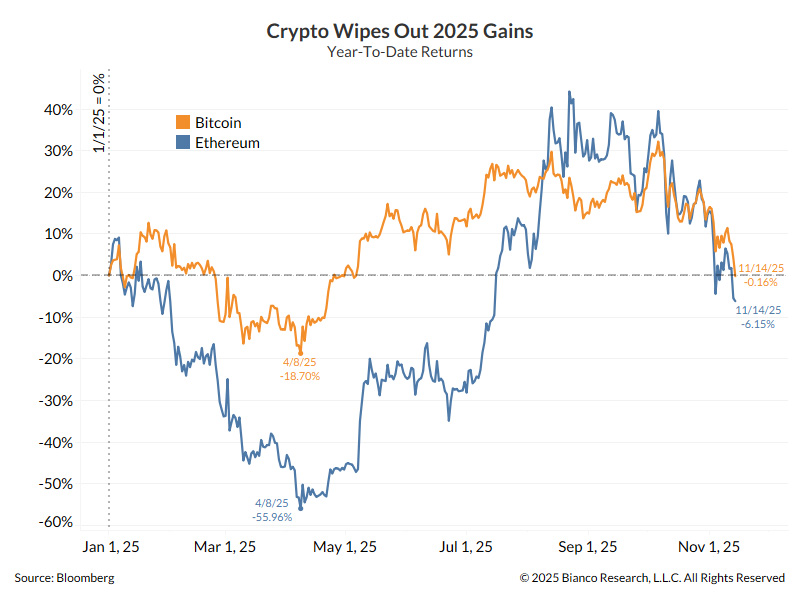 Crypto destroys the year’s gains of 2025, from November 15, 2025. Source: Bianco Research
Overall, Bitcoin has lost almost 15% in value since the beginning of the year at its peak. For many altcoins, the balance sheet is even significantly more negative. In contrast, Ethereum, with prices just above USD 3,000, is still slightly in the black since the beginning of the year.
2. Chart Analysis Bitcoin in US Dollars
2.1 Weekly Chart: Weekly Stochastic Overbought

Bitcoin in USD, weekly chart from November 18, 2025. Source: Tradingview
At USD 126,272, Bitcoin reached a new all-time high again on October 6. However, the rise to new highs has been increasingly difficult since mid-July. Ultimately, however, the price target from the large cup-and-handle formation was worked off in a fairly exemplary manner.
This sluggish progress on the way up led to a sell signal in the weekly stochastic as early as the end of July, so that a negative divergence increasingly spread on the weekly chart since midsummer. The price slump of the last few weeks was accordingly only the consequence.
With a low of USD 89,189, the pullback led Bitcoin back to the middle trend line of its large upward trend channel today. Accordingly, it can be argued that the overriding upward trend since the end of 2022 is still intact. At the same time, the weekly stochastic is oversold again for the first time since the end of March.
In summary, the weekly chart is of course bearish at first due to the strong price losses, because the strong pullback weighs heavily. However, the oversold situation together with the support around USD 89,000 make the remaining downside risk appear very manageable in the short term. We therefore suspect that Bitcoin is now more likely to be at the beginning of an at least several-week recovery. In the best case, the next multi-month push to new all-time highs will start now.
2.2 Daily Chart: Trend Reversal

Bitcoin in USD, daily chart from November 18, 2025. Source: Tradingview
On the daily chart, the bears pushed Bitcoin almost 30% into the depths in the last six weeks. Starting from the new all-time high on October 6, Bitcoin lost over USD 37,000! Accordingly, the daily chart is now completely oversold. In addition, the price action of the last five days since the break below USD 100,000 smells like capitulation.
In the course of the day, there is a first reaction, so that Bitcoin is currently trading again at around USD 93,500. We therefore probably saw the low of the correction today and Bitcoin is now starting a recovery.
However, the way up is paved with strong resistance. A first target would be an old resistance line around USD 97,500. Above that, the psychological mark of USD 100,000 and the 38.2% retracement at USD 103,355 are waiting. The distance to the sideways 200-day line (USD 110,436) is considerable at over 18%. Nevertheless, the 200-day line together with the 61.8% retracement (USD 112,106) would be the logical target of a larger recovery.
In conclusion, Bitcoin should have marked an important low today and should now start on the way to a larger recovery. The heavily oversold daily stochastic provides enough room for a strong reaction.
3. Sentiment Bitcoin – Completely Bombed Out Mood
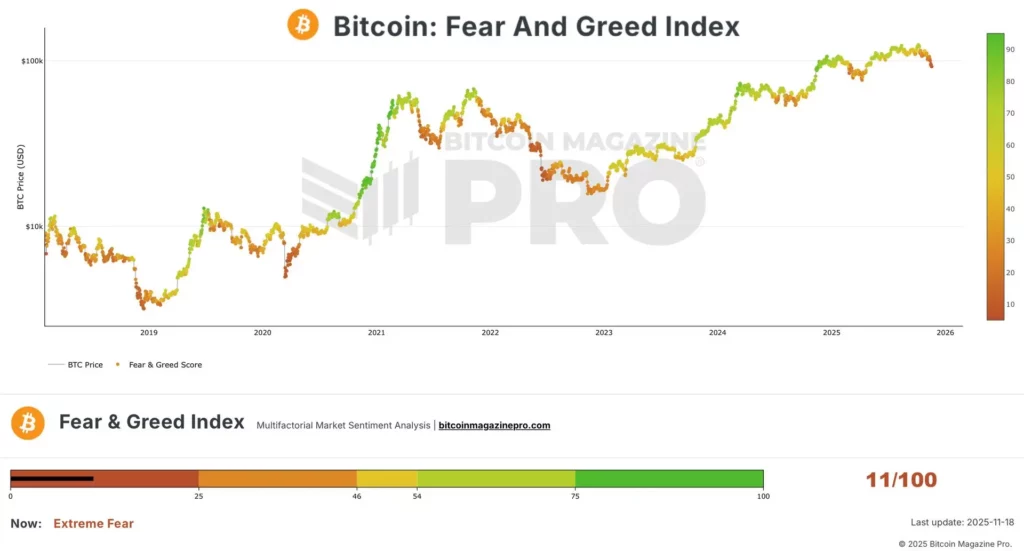
Crypto Fear & Greed Index from November 18, 2025. Source: Bitcoin Magazine Pro.
The “Crypto Fear & Greed Index” currently stands at 11 out of 100 points, signaling extremely high levels of fear and panic among crypto investors. Such a low value – the lowest in over two years – reflects the ongoing uncertainty triggered by a chain of negative developments: regulatory crackdowns in several countries, the collapse of smaller altcoins, liquidations in the billions on the derivatives markets, and the ongoing downward spiral of the Bitcoin price below the USD 95,000 mark. Many private investors, who were still reveling in euphoria in the summer with index values beyond 80, are now withdrawing capital or hedging their positions.
Historically, however, such extreme fear values often mark the trend reversal. In fact, such panic phases have often been followed by strong recovery rallies within the following two to twelve months. Whether the current low point at USD 89,189 already represents the turning point or whether further sell-offs are imminent remains open – what is clear, however, is that the market is currently in a phase of maximum emotional stress, in which rational analysis is often overlaid by sheer fear.

CMC Crypto Fear & Greed Index from November 18, 2025. Source: Coinmarketcap
The “CMC Crypto Fear & Greed Index” from CoinMarketCap also reports extremely high panic in the crypto sector with a value of 16.
In summary, the crypto market is in a state of abandonment. The mood is as bombed out as it has not been since spring; however, it is precisely these extreme levels of fear that have repeatedly initiated the strongest and most sustainable increases in the past.
4. Seasonality Bitcoin – Trend Reversal Mid-November?

Bitcoin Seasonality from November 18, 2025. Source: Seasonax
Bitcoin has always followed pronounced seasonal and cyclical patterns, which are strongly influenced by the four-year halving cycle: Typically, the bull market reaches its high about 12–18 months after the halving (the last one took place in April 2024), with historical peaks mostly in the first half of June – followed by a correction phase in the summer and a bottom or the trend reversal in early autumn or by mid-October.
In the current year 2025, however, there is a noticeable shift of around one month: The expected high, which in earlier cycles often occurred as early as June, this time manifested itself in several steps in July, August and ultimately at the beginning of October, which shifted the entire curve backwards and significantly extended the euphoria phase. This delay – possibly due to institutional ETF inflows, delayed macro effects and a longer accumulation phase – now means that the classic autumn correction and the phase of “extreme fear” may not reach their low point in October as usual, but only in mid-November.
Accordingly, the chances are good that the crypto market is immediately before an important bottom and the beginning of a recovery that could last until the coming spring.
Overall, the seasonal traffic light is green, and should soon provide for the start of a multi-month recovery phase for Bitcoin.
5. Bitcoin against Gold (Bitcoin/Gold Ratio)
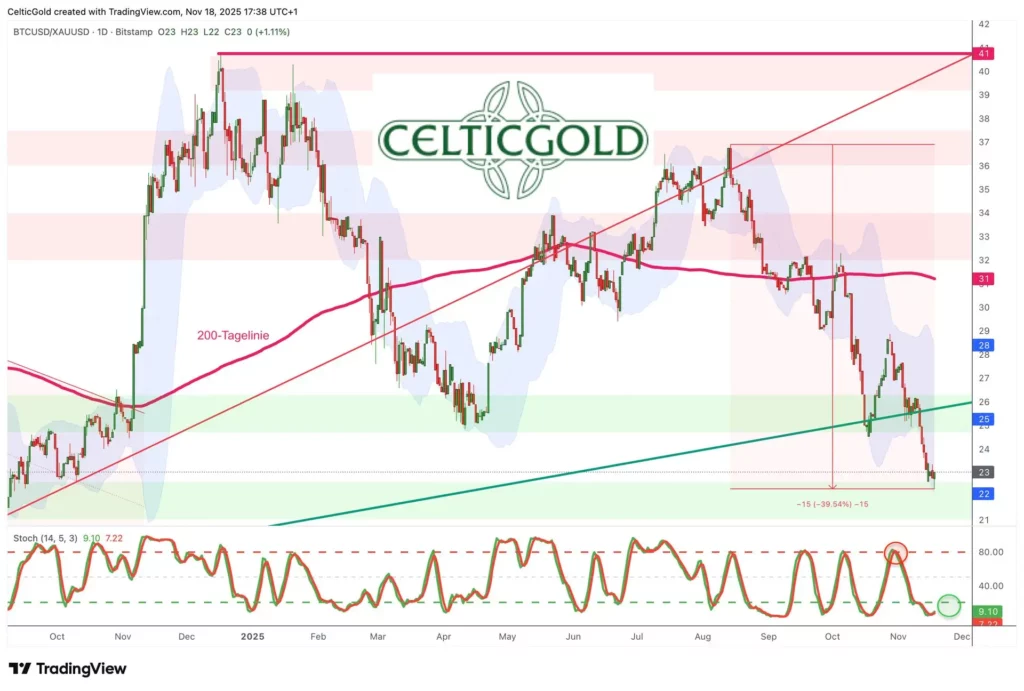
Bitcoin/Gold Ratio, daily chart from November 18, 2025. Source: Tradingview
At prices of around USD 93,500 for one Bitcoin and approx. USD 4,070 for one troy ounce of gold, one currently has to pay around 23 ounces of gold for one Bitcoin. Conversely, one troy ounce of gold currently costs approx. 0.044 Bitcoin. This means that Bitcoin has fallen dramatically against the gold price by around -40% since the last trend reversal on August 14!
While gold climbed to a new all-time high of USD 4,381 in October due to massive central bank purchases, geopolitical uncertainties and inflation fears, Bitcoin recently lost around 29.3% since its new all-time high of USD 126,272.
This massive outperformance of gold underlines the current risk-off mode of the markets: investors are fleeing into the classic safe-haven asset, while risky digital assets such as Bitcoin are being massively punished together with the tech stocks. In the course of the large capital market rotation, gold outperforms pretty much everything. This overriding trend is likely to continue independently of counter-movements and recoveries in the coming one to two years.
In the short term, however, the heavily oversold daily and weekly stochastic on the Bitcoin/Gold ratio should force a trend reversal in favor of Bitcoin in the near future. In view of the extreme fear (Fear & Greed Index at 11), the seasonally strong November to January phase and the cycle dynamics shifted by one month in 2025, the probability increases significantly that we are experiencing the turning point right now and that the ratio can recover again in the direction of approx. 30.
In summary, the Bitcoin/Gold ratio is heavily oversold and suggests a recovery movement in favor of Bitcoin.
6. Capital Market Rotation in Favor of Gold Continues
The global financial markets are at a historic turning point. The credit cycle, which has been inflated for decades and fueled by zero interest rates, floods of liquidity and financial innovation, seems to be reaching its natural and logical end. In the leading stock indices, in the so-called “Magnificent Seven” US tech stocks as well as in the crypto market, the first cracks are appearing in the foundation. Euphoria gives way to nervousness, momentum gives way to skepticism – and capital quietly, but surely, seeks its way back to a millennia-old haven: gold.
Credit Bubbles and the Psychology of the Late Cycle
The signs of a bursting credit bubble are hard to miss. In the USA, margin loans climbed to record highs of over USD 1.18 trillion – a clear indication of speculative excesses. Stock prices, especially in the technology sector, have long been decoupled from the fundamentals; what counts is not the value, but the current fashion trend (see e.g. “meme coins”). But this mood is more fragile than ever: Bitcoin, as an ultimate expression of the “easy money” psychology, has lost almost 30% in the last six weeks.
Repo Markets as an Early Warning System
At the same time, the tensions on the US repo market have intensified into a writing on the wall. Short-term refinancing rates show nervous fluctuations – a classic symptom of dwindling liquidity. The Federal Reserve wants to react to this by announcing the end of its balance sheet reduction (QT) on December 1, but this is not a sign of strength, but a desperate attempt to prevent a larger crash. Liquidity is shrinking, while global debts are exploding. And the markets, which are heavily dependent on new liquidity, are demanding more, because if liquidity is lacking, risky assets break down first.
Inflation as “Silent Expropriation”
The heart of the problem remains the structural imbalance between debt and productivity. With global M2 money supply at a record level of USD 137 trillion, there can be no talk of monetary policy normality. The consequence: persistent inflation that devalues real assets and drives investors into tangible assets. Gold benefits massively from this – not because it “grows”, but because everything else shrinks.
The Turning Point in Investor Behavior
While established market participants are still clinging to the Wall Street rhetoric of the “soft landing”, large investors are shifting their allocations. The example of Stan Druckenmiller speaks volumes: away from US stocks towards substance-driven sectors, commodities and structural growth themes. At the same time, central banks worldwide are massively increasing their precious metal reserves.
The End of the “Everything Bubble” Era?
The last few years have been characterized by the so-called “Everything Rally” – stocks, bonds, cryptos, real estate and art objects rose together. But this correlation was unnatural and credit-driven. The current rotation signals a reorganization. Where diversification used to bring performance, only substance will survive in the future. Gold acts as a valuation anchor in a world that has largely lost touch with the real economy.
Politically Induced Crisis of Confidence
Parallel to the market dynamics, distrust of the political controllability of the financial order is growing. Government interventions, such as digital central bank currencies or asset registers, fuel the fear of creeping expropriation. The citizen senses that freedom and money are becoming increasingly dependent on each other. Precious metals – anonymous, uncensored, limitless – appear in this context not only as an investment, but as the last remnant of personal sovereignty.
Gold as a Mirror of Geopolitical Power Shifts
Gold is also gaining strategic weight in the global context. The West is facing fiscal overstretch, while numerous emerging countries are using gold to emancipate themselves from the US dollar. China, India and Russia are continuously buying physical stocks and building a modern infrastructure for gold-backed payment systems. This development points to a multipolar financial world in which precious metals are once again becoming monetary anchors.
The Retreat into the Tangible
Investors who have trusted in the “paper money comfort” for decades are now discovering the virtue of the tangible. In crisis phases, physical gold retains that rare property that no paper promise can offer anymore: finality! Unlike Bitcoin or government bonds, its value does not depend on the solvency or accessibility of third parties.
Between Liquidity Trap and Crisis of Confidence
At the same time, the danger of a deflationary spiral is growing if credit expansion stalls. In a system that generates growth only through new debt, every decline in liquidity becomes an existential threat. Accordingly, the central banks are in a trap: more money printing means more inflation, less money printing means system collapse. In both cases, gold wins as insurance against the loss of control.
Historical Parallels and Strategic Outlook
Whether one draws parallels to the golden 1920s or the 1970s – the pattern repeats itself: over-indebtedness, displacement of the real economy, breach of trust, and in the end flight into metal. The rotation towards gold is not a fashion, but a return to economic reason. The longer the credit-driven system is artificially kept alive, the more violent the later compensation.
Markets Force the Next Interest Rate Cut
For the far-sighted investor, preparation is required today, not panic, because the policy of “playing for time” is reaching its limits.

Global liquidity, from November 17, 2025. Source: Michael Howell
While the Federal Reserve ends its QT program on December 1, the US is simultaneously preparing for new stimulus payments of USD 2,000 per citizen. At the same time, Japan is fueling a USD 110 billion package, China even one over USD 1 trillion. Canada is also returning to quantitative easing, and the global number of interest rate cuts has already exceeded 320 in two years. Worldwide, the M2 money supply is reaching new record levels with Bio. USD.
These measures do not mark a stabilization, but the forced capitulation to an impending credit crunch. This is the desperate attempt to artificially keep a highly indebted system alive and the longer the collapse is delayed, the greater the final suffering will be. The markets are thus dictating the direction to the central banks: back to cheap money – and inevitably on the path of a new wave of inflation.
Gold Will Continue to Outperform Bitcoin in the Bottom Line
Bitcoin and especially gold & silver form the last bulwarks against this looming paper money flood. While paper assets such as stocks, bonds and insurance policies lose substance in the coming reorganization and literally evaporate, precious metals retain their value stability – they escape both expropriation and the control of digital central currencies. We expect both gold and silver to reach new record levels in the coming year after the current breather, once again leaving all paper asset classes behind.
The foreseeable global liquidity expansions should also create a friendly environment for Bitcoin. The ongoing capitulation in the crypto market – larger than during the COVID crisis or the FTX disaster – has flushed the excess leverage out of the system, creating the breeding ground for the next Bitcoin upswing. Nominally measured in US dollars and euros, it should increase significantly, but hardly become more expensive in real terms when valued in gold – proof of the continued monetary dominance of the precious metal.
In short: As soon as the United States finally flip the switch to a new round of quantitative easing, the grand finale will be ushered in – with the endpoint of an inflationary devaluation spiral that will inevitably be reminiscent of the Weimar hyperinflation.
7. Conclusion: Bitcoin – Panic Brings the Trend Reversal
Following the sharp price drop, the crypto market is in crisis, characterized by high uncertainty and severely oversold conditions. The ongoing Bitcoin capitulation is larger than those during the COVID crisis or the FTX debacle. Nevertheless, the cleanup of excessive speculation now lays the groundwork for a sustainable recovery. This could not only lead Bitcoin back above $100,000 in the coming months but also target the 200-day moving average in the range of $110,000 to $112,000.
For precious metals, the bull market is expected to continue from mid-December or January at the latest, driven by geopolitical tensions, the flight to safe haven assets, and the unresolved global debt crisis. While Bitcoin is likely to gain nominally against the US dollar and Euro, its valuation in gold remains stable at best, underscoring the continued importance of the precious metal as a monetary anchor.
The long-term capital market rotation continues to favor gold and silver as robust hedges against impending inflation and increasingly fragile paper assets such as stocks, bonds, and insurance. New liquidity expansions and foreseeable stimulus programs around the globe are forcing central banks back onto the path of interest rate cuts. The next flood of fiat money will make another inflationary wave inevitable. These conditions point to a further strong increase in precious metal prices in the coming months and years – a trend that will continue to outperform traditional financial assets.