Quimbaya Gold (WKN A3DT3C / CSE QIM) is aggressively advancing its drilling campaign in one of Latin America’s most renowned gold regions. Now, the company can report a first discovery!
As recently reported, CEO Alexandre P. Boivin’s company has identified two new mineralized vein systems on its 100% owned Tahami South Project in the Segovia-Remedios Gold Belt of Colombia’s Antioquia province. With the latest drilling results, Quimbaya Gold now sees a central part of its geological working hypothesis confirmed: The structurally controlled gold mineralization of the Segovia district apparently extends from the property of the producing, multi-billion dollar neighbor Aris Mining onto its own concessions!
Quimbaya Gold Confirms S and V Systems at Tahami South
As part of the ongoing drilling program at Tahami South, Quimbaya Gold has intersected several vein structures, including the already modeled target zones Vein S and Vein V. Mineralized intervals were encountered in eight out of nine drill holes, indicating good agreement between the geological model and actual structural development. The new veins are formed as quartz-barite-carbonate veins with a sulfide assemblage of pyrite, chalcopyrite, galena, and sphalerite – a mineralogy consistent with the systems mined in the Segovia district.
Quimbaya Gold classifies the findings as confirmation that the tectonic architecture of the Segovia-Remedios Belt extends onto the Tahami South Project. The project is located in close proximity to one of Colombia’s largest gold producers, Aris Mining, within an established gold corridor, which underscores the structural context of the new discoveries.
CEO Alexandre P. Boivin described the initial results as a turning point for Quimbaya Gold, as the company transitions from mere land acquisition to a phase of value creation through exploration. For VP Exploration Ricardo Sierra, the drilling data show clear continuity in the structure, mineralogy, and geometry of the mineralization, as is typical for the Segovia district.
Drilling Program at Tahami South Exceeds Original Scope
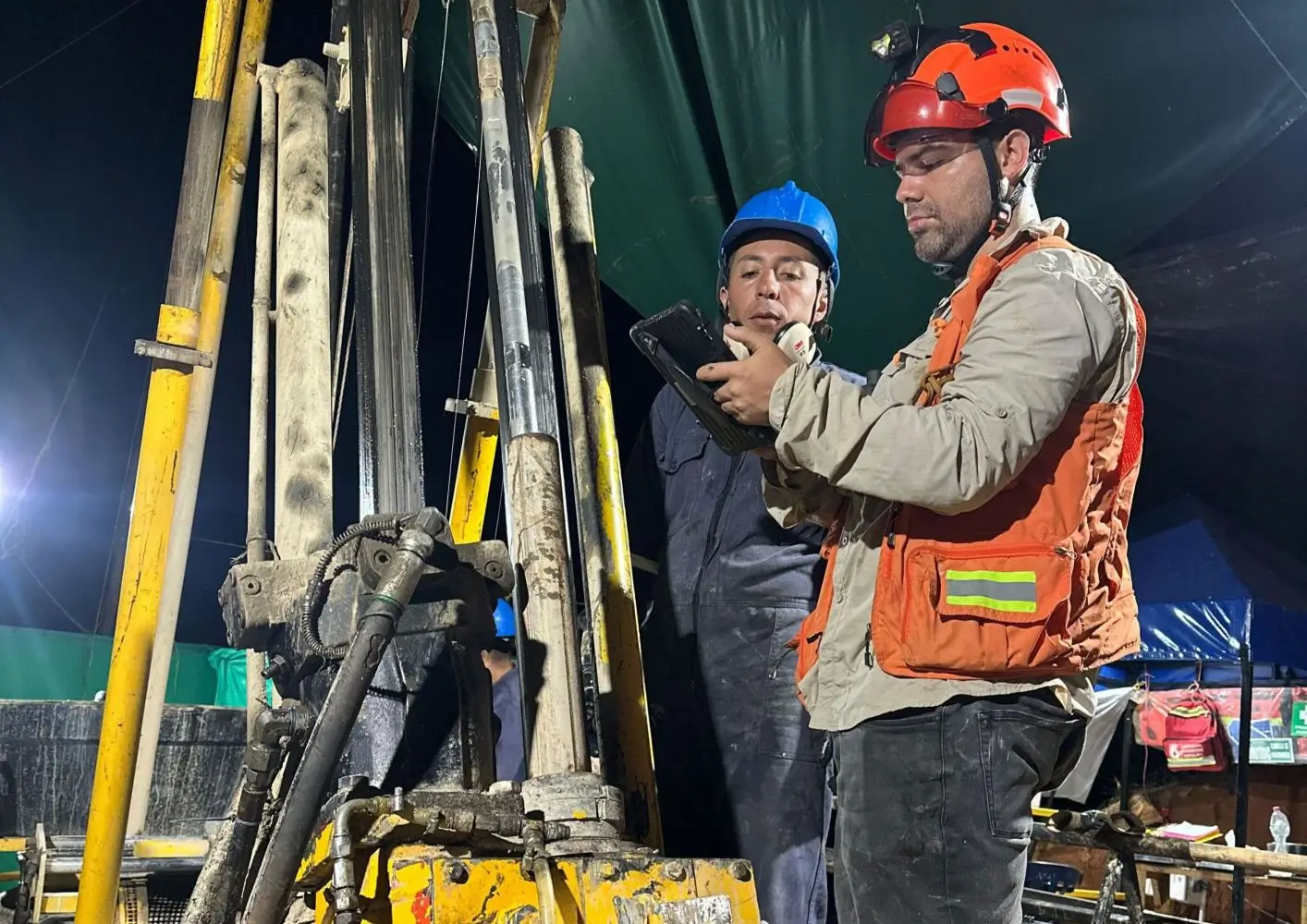
The Phase 1 drilling program at Tahami South is still underway and has already exceeded 4,000 meters drilled, surpassing the originally planned scope. Drilling is being conducted from multiple platforms to map the orientation and extent of the mineralized veins both along strike and at depth.
The fact that eight out of nine initial drill holes show mineralization is considered by Quimbaya Gold as proof of robust target definition. The previously identified vein systems S and V are now being followed in all directions to more accurately determine continuity and thickness. Tahami South is located within a proven district where vein-hosted, high-grade gold systems have historically played an important role. The current program aims to clarify the extent to which these patterns continue on Quimbaya’s concessions.
Although initial laboratory results are already available, the company intends to publish the full analyses only when a “critical volume of data” has been achieved. According to Quimbaya Gold, it deliberately pursues the approach of presenting the assays in a consolidated form to be able to illustrate mineralization distribution and structural relationships within a consistent geological framework.
Quimbaya Gold Sees Exploration Thesis Confirmed
The discovery of the mineralized S and V systems at Tahami South is considered by Quimbaya Gold as the first clear technical confirmation of its overarching exploration thesis. The company had strategically built up its land positions in areas where gold and silver occurrences are visible at the surface and are located in close proximity to active producers. The results now reported indicate that large-scale mineralized structures do not end at existing mine boundaries but extend into previously underexplored areas.
With the expansion of the drilling program beyond its original target, Quimbaya Gold is focusing on the further evaluation of the S and V veins. The goal is to better define the continuity along strike and at depth and to derive clear vectors for a systematic expansion program in 2026. From the company’s perspective, the close correlation between the initial drill intercepts and the geological model strengthens the basis for further infill drilling.
Capital Base Strengthened for 2026 Program
Parallel to the progress at Tahami South, Quimbaya Gold has strengthened its capital base this year. In the second half of 2025, a total of 2,169,164 common shares were issued through the exercise of options and warrants, generating gross proceeds of approximately 874,665 Canadian dollars for the company. These funds are classified as a non-dilutive strengthening of liquidity and are intended to underpin the budget for the fully funded 2026 drilling program.
Furthermore, Quimbaya Gold has granted 614,034 Restricted Share Units to members of management and the Board. The RSUs are subject to the provisions of the existing equity compensation plan and the policies of the Canadian Securities Exchange and vest over time. According to the company, these equity incentives are intended to help retain the management team at Quimbaya Gold long-term and align their interests closely with those of the shareholders.
With the combination of the strategically located Tahami South Project, initial confirmed mineralized vein systems, and a strengthened balance sheet position, Quimbaya Gold is preparing for the next phase of exploration. The coming months are expected to be characterized by further drilling results, more precise delineation of the S and V veins, and the planning of an expanded drilling program for 2026 in the heart of Colombia’s Segovia-Remedios Gold Belt.