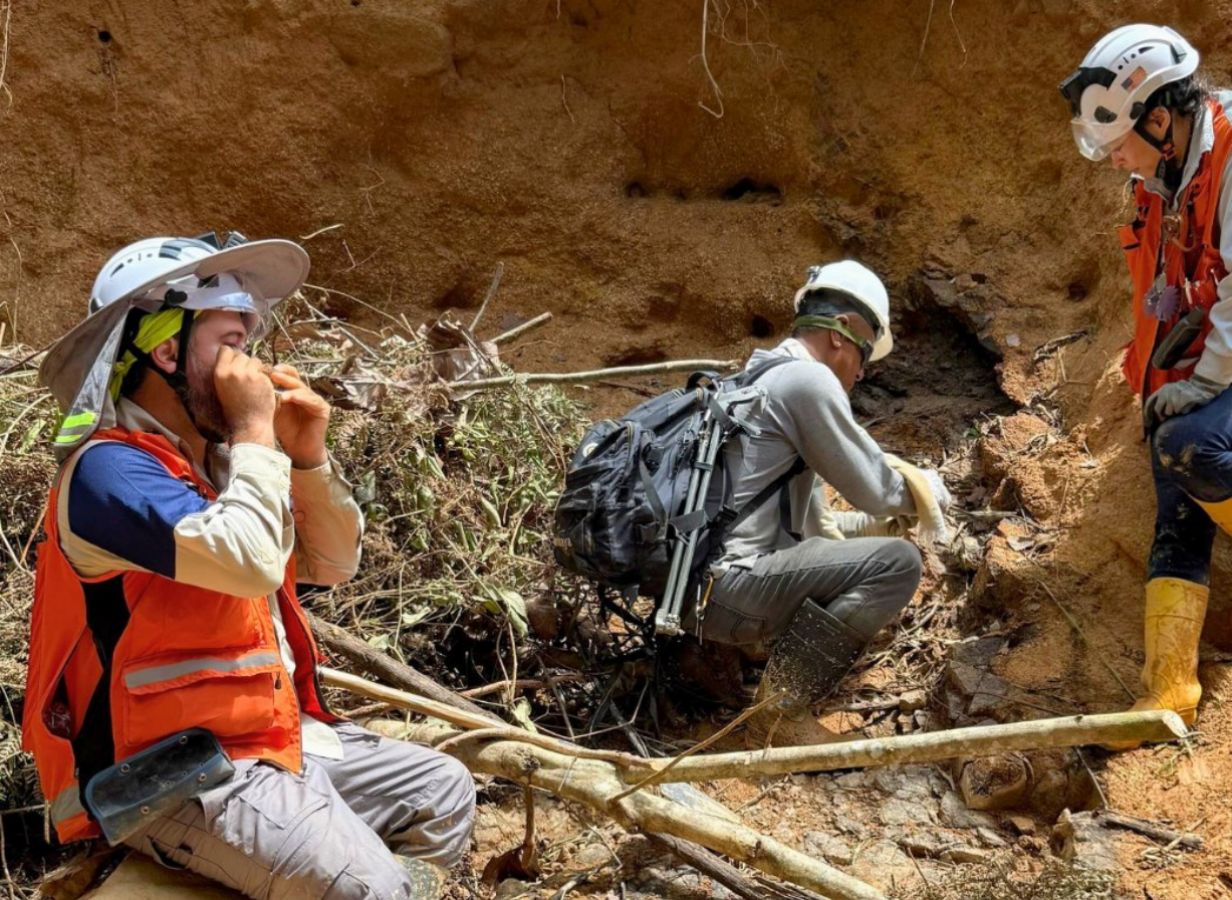

Quimbaya Gold (CSE: QIM; OTCQB: QIMGF; FSE: K05) has exciting news! As was just released, the company discovered a copper, molybdenum, and gold porphyry target covering several square kilometers at its Tahami Center project!
This promising structure is located approximately 2.5 kilometers northeast of the ongoing drilling at the Tahami South target area in the province of Antioquia, Colombia. According to Quimbaya, it currently measures approximately 2.0 × 1.4 kilometers. Mapping, mineralogy, and initial geochemistry indicate a classic porphyry system with epithermal high-sulfidation overprint at the surface. There are also active, small-scale gold mining sites within the target area – an important indication of near-surface gold mineralization.
Location and Geological Setting
The Tahami Project is located in the productive Segovia Belt, a region of Colombia where gold has been mined for decades. While high-grade epithermal veins are well documented in Colombia, the potential for copper-gold-molybdenum porphyries is considered underexplored in many areas. Quimbaya Gold sees the combination of scale, preservation, and surface expression of the system as a geologically rare setting that fits into the company’s broader district model. The proximity to existing mining operations in the corridor, including Aris Mining’s Segovia operations, adds further context to the location.
Geologically, the company describes a complete alteration pattern typical of mature porphyry systems: potassic zones with biotite-magnetite assemblages, a quartz- sericitic overprint, and highly sulfidic, advanced argillic lithocap. Terraspec analyses – carried out at the Universidad Nacional de Colombia – confirmed minerals such as alunite, pyrophyllite, dickite, and kaolinite. The interpreted vertically zoned system – porphyry at depth, epithermal above – fits global comparative examples and at the same time explains the gold occurrence at surface.
Initial Geochemistry and Surface Observations
In addition to alteration, Quimbaya Gold points to a complete porphyry vein sequence (A, M, EB, B, and D) that has been mapped at several outcrops. Visible mineralization includes copper oxides and sulfides such as chalcopyrite and chalcocite, as well as molybdenite; secondary copper minerals (including chalcanthite and brochantite) have been identified at the surface. Gold flakes (“gold in pan”) found in streams further confirm the ore occurrence.
Early geochemistry supports this picture: an initial rock channel sample over 2.10 meters returned 0.12% Cu, 301 ppm Mo, and 0.10 g/t Au. Up to 304.5 ppm Cu, 66 ppm Mo, and 0.29 g/t Au were measured in river sediments; with several samples from the Robusta and Bourbon prospecting areas showing elevated grades. Further multi-element analyses for additional sediment samples and results from 54 meters of underground channel samples are still pending. Such early data sets are an indication only, so far, but provide guidance for prioritizing surface drill targets.

The strategic location is particularly relevant: the new target is only a few kilometers away from the active drill sites at Tahami South which in turn are close to Aris’ Segovia operations. This allows Quimbaya Gold to use local logistics and teams to efficiently plan follow-up work – from detailed mapping and geophysical methods to initial drill tests.
Significance for Quimbaya Gold and next steps
For Quimbaya Gold, the identification of a large, preserved porphyry system at the surface is a strategic building block. Porphyries containing copper, molybdenum, and gold are important deposit types worldwide which, depending on their extent and grades, can allow for both bulk tonnage scenarios and high-grade epithermal sub-areas. At Tahami, the combination of lithocaps, a complete vein inventory, and multi-stage alteration suggests that the system is not eroded and could continue at depth. Systematic drilling programs are needed to clarify whether and to what extent this is the case.
At the operational level, the company is now expected to intensify mapping, expand geochemical grids, and use geophysical surveys (e.g., magnetic or IP) to refine lead structures and potential intrusion centers. Based on this work, priority targets for scout drilling are likely to be defined. At the same time, drilling at Tahami South is continuing, which increases the density of data in the southern part of the land package and allows cross-comparisons within the district.
Overall this means that Quimbaya Gold can combine the Cu-Mo-Au potential of Tahami Center with the epithermal gold targets in the surrounding area. The company points out that it has one of the few consolidated property positions in this section of the Segovia Belt – an aspect that facilitates the implementation of coherent exploration programs. (Of course, exploration still remains subject to geological and permitting risks; early-stage data sets are inherently limited and may change as work progresses.)
Conclusion: Quimbaya Gold has delineated an extensive porphyry target at Tahami Center, supported by alteration, vein types, and early geochemistry. The proximity to current drilling at Tahami South, active gold mining in the target area, and a consistent geological model form a promising basis for the next exploration steps. This discovery reminds us a little of the early days of another extremely successful company in Colombia called Collective Mining, which now has a market cap of >CAD 1.7 billion… We are excited to see what CEO Alexandre Poivin’s team will do with this discovery in the future!