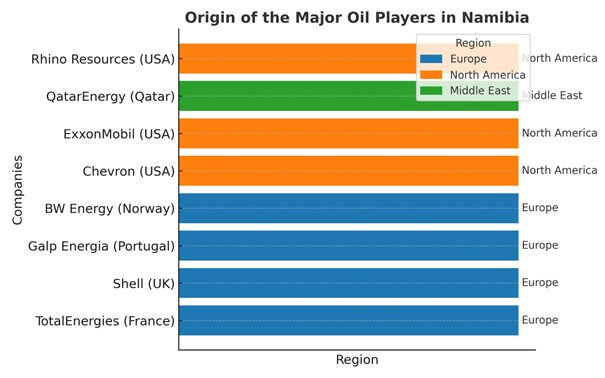
Almost unnoticed by the general public, Namibia has developed from a blank spot on the oil map to one of the most exciting exploration destinations in the world in just a few years. With spectacular offshore discoveries in the Orange Basin, the country is moving into the same league as recent success stories such as Guyana and Suriname. Experts believe that Namibia could become one of the ten largest oil producers worldwide by 2035. European oil players are prominently represented: while oil majors such as TotalEnergies (France), Shell (UK), and Galp (Portugal) are investing billions, Oregen Energy Corp. (CSE: ORNG | FSE: A1S), a Canadian exploration company, has secured a place in the front row at an early stage.
Oregen is pursuing a clear strategy: through its early positioning in the so-called “String of Pearls” trend, the targeted increase of its stake in the promising Block 2712A, and the planned entry into further licenses, the company aims to become one of the most prominent junior players in the Orange Basin. The company does not intend to drill itself, but instead relies on modern 3D seismic technology and aims for future farm-outs to majors. This opens up a rare early-stage opportunity for investors with considerable leverage in case of success.
From a Fringe Area to a Global Hotspot
Just a decade ago, Namibia’s coastline was largely unexplored. Initial drilling efforts were mostly unsuccessful, and the region was long considered too expensive and too risky. It was only recent advances in seismic exploration and geological analogies with West Africa that led to a breakthrough. Since then, the picture has changed dramatically. TotalEnergies struck an estimated 5.1 billion barrels in the Venus field – the largest discovery in sub-Saharan Africa. Shell confirmed further billion-barrel reserves with the Graff and Jonker discoveries. Finally, in early 2024, Galp Energia published impressive estimates for the Mopane field, which could contain up to 10 billion barrels of oil equivalent. Taken together, Namibia’s offshore reserves now total around 20 billion barrels of oil – a potential that could permanently change the energy market. energy market.
Political Stability as a Locational Advantage
Namibia’s appeal is determined not only by its geology, but also by a political and regulatory environment that provides security for investors. The country is considered one of the most stable democracies in Africa, and corruption plays a lesser role compared to other resource-rich countries. The government pursues a pro-investor strategy and supports the rapid development of offshore fields. Profits from oil transactions are subject to 35 percent tax, plus a five percent royalty. Through the state-owned oil company Namcor, Namibia holds a ten to fifteen percent stake in all projects. These conditions are considered moderate by international standards and make Namibia equally attractive to international oil companies and exploration companies.
Oregen Energy as an Early Player
And now, Oregen Energy is entering this environment. On August 26, 2025, the Canadian Securities Exchange (CSE) approved the change of name from Supernova Energy to Oregen Energy. Since August 27, the stock has been listed under the new ticker symbol ORNG (CSE) and continues to be listed in Frankfurt under the ticker symbol A1S. With only around 64.6 million fully diluted shares, the capital structure is comparatively lean. In August, the first tranche of equity financing totaling CAD 3.6 million was also successfully completed – a further step toward securing the planned work programs.
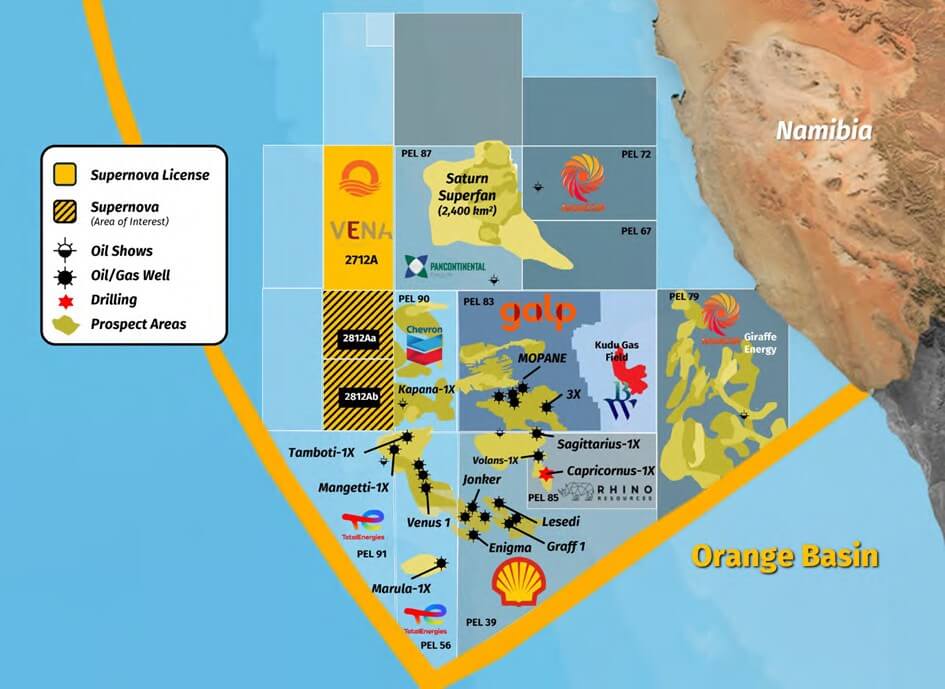
Oregen initially secured an 8.75 percent stake in Block 2712A in the Orange Basin and increased this to 33.95 percent in August 2025 through a stake in the operator WestOil Ltd. This means that the company will play a key role in the further development of the license area in the future. The block covers 5,484 square kilometers in water depths between 2,800 and 3,900 meters – exactly where TotalEnergies, Shell, and Galp have made their latest major discoveries.
Tim O’Hanlon, Senior Advisor at Oregen and former Africa head of Tullow Oil, sums up the significance: “Oregen is positioning itself as one of the few publicly traded junior players with direct exposure to the most significant offshore discoveries of recent years.”
Block 2712a: on the “String of Pearls” Trend
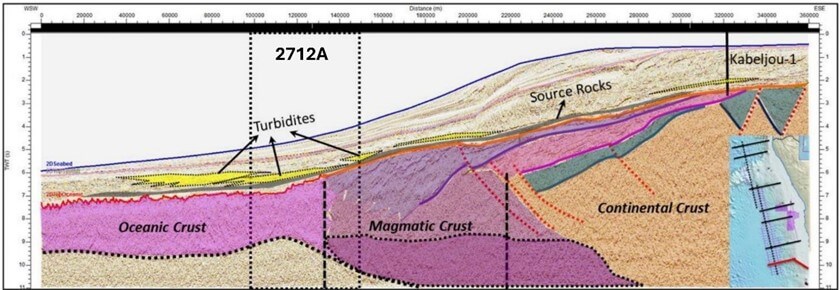
The geological location of Block 2712A is exceptional. It lies immediately north of and on the same geological trend as the major discoveries Venus, Graff, and Mopane. The subsurface is fed by the Kudu Shale Formation – the source rock that also charges the neighboring fields. Satellite images show natural oil streaks directly above the block, indicating active hydrocarbon migration. Regional seismic data also points to turbidite fans, large-volume and well-sealed reservoir structures that are considered ideal storage for light oils.
In November 2025, Oregen will conduct a high-resolution 3D seismic campaign covering 3,000 square kilometers to verify these hypotheses. This data is considered a crucial milestone: it should enable the transition from geological analogies to clearly defined drilling targets – and thus open the door for farm-out negotiations with supermajors.

Oregen Roadmap to 2027
Oregen is pursuing a clear strategy. In 2025, the focus will be on 3D seismic data, accompanied by an independent NI 51-101 report. In 2026, a structured farm-out process is set to begin, with international partners coming on board to share costs and risks while providing capital for the next steps. The first exploration wells could then begin being drilled in 2027. At the same time, Oregen is looking into other investments in Namibia, including a letter of intent for a seven percent carried interest in an additional offshore project.
Namibia Following in Guyana’s Footsteps
Developments in the Orange Basin are strongly reminiscent of Guyana. ExxonMobil discovered the first major offshore reserves there in 2015, and today the country already produces over 600,000 barrels per day. Namibia could follow this pattern: geologically promising deepwater basins, early successes by international majors, political stability, and a government that supports a rapid transition to the production phase. Ian Thom, Research Director at Wood Mackenzie, puts it this way: “Namibia is following the same trend as Guyana, Suriname, and Senegal—regions that have developed from exploration hotspots to globally relevant oil provinces within a few years.”
An Early-Stage Opportunity for Investors
The momentum in the Orange Basin is enormous: more than ten new wells are planned for 2025 and 2026. The market is paying particular attention to TotalEnergies, which plans to make a final investment decision on the Venus field in 2026 – a historic milestone that would catapult Namibia from the exploration to the production era for the first time.
For investors, Oregen Energy presents a classic early-stage opportunity: entry is risky, but the leverage in case of success is considerable. Should Namibia repeat Guyana’s path, Oregen could have a stake in one of the most exciting energy stories of the decade with Block 2712A. The small Canadian explorer is in early stages, strategically positioned, and ready to grow with strong partners—a combination that promises exceptional potential in a hot market environment.