
Multiple visible gold near surface and Up to 23.27 g/t Au Over 4.5m and 6.85 g/t Au Over 12.35m near Surface
To support the planned Phase 1 exploration of the new prospecting program at the Melba Mine, Heritage Mining (CSE HML, FSE: Y66, WKN: A3DTM6) has conducted a re-evaluation of the historical drill cores acquired with the project. The previous owners had drilled in zones close to the surface, and the historical drill cores documents revealed not only visible gold but also mineralization with up to 23.27 g/t gold over 4.5 meters and 6.85 g/t gold over 12.35 meters.
The acquisition of the project, which only took place in September 2025, could therefore prove to be a timely move. Located in the northeast of the Canadian province of Ontario, the property is part of the Timmins/Kirkland gold district and is thus situated in an extremely productive and promising part of Canada. The who’s who of the Canadian mining industry is represented here with its own projects, and to the southeast is the Ross Mine, which gave its name to the Ross Fault of the same name. The Melba project comprises individual claims with a total area of 1,522.70 hectares and also includes a mining concession.

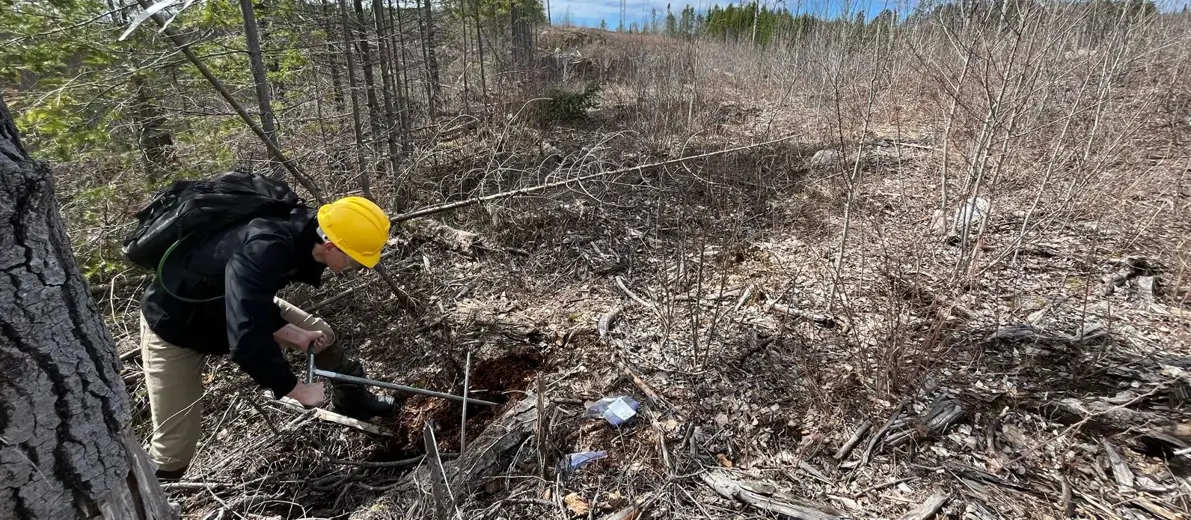
Immediately after the acquisition, Heritage Mining began working on a new exploration program. It is scheduled to start shortly and includes diamond drilling to confirm several historical results during the remaining months of the year. Current plans assume that a total of 26 holes with a total length of approximately 1,780 meters will be drilled.
Planning for an initial drill and exploration program is nearing completion.
The drilling will be supplemented by systematic groundwork. The plan is to take further samples of remaining ore and bedrock in the immediate vicinity of the historic mine. The focus will be on the ore dump. A bulk sample taken here in 2012 yielded average gold grades of 3.99 g/t gold. It is currently estimated that the dump could contain 2,000 tons of mineralized ore with 230.90 ounces of gold.
Heritage Mining will pay particular attention to the veins discovered by previous owners through historical prospecting and excavation work. Of the four veins—Rolling Vein, Blue Vein, Meike Vein, and Contact Vein—the Blue Vein is currently considered the most important. It was mined underground and has several historical occurrences of visible gold. In addition, a valuation report from 1962 is available.

The Focus Will be on the Blue Vein
The Blue Vein runs north 55 degrees west and dips 55 degrees to the north. It is associated with shearing and alteration, but also contains a pattern of cross-cutting fractures that have led to faults in the main vein. This has created irregular secondary veins in the adjacent rocks.
The main vein of the Blue Vein is offset 18.2 meters to the north near the shaft. Further offsets have been identified underground. The geological conditions are similar to those of the sedimentary belt in the Beatty-Munro area, and numerous feldspar porphyry, diorite, and basic syenite veins were intersected during historical drilling at the .
Overall, a significant portion of the drill cores showed alteration, some to a high degree, while carbonate veins were numerous. Visible gold was also found in many drill cores, which is an indication of attractive mineralization, too. The Heritage Mining team will be following up on these numerous clues and indications intensively and systematically in the coming weeks.
Heritage Mining is committed to realizing the potential of the Melba Mine.
The potential is definitely there. Since there is still ore available on the surface and the mineralization is found very close to the surface, it makes a lot of sense for Heritage Mining to consider whether and, if so, how the existing infrastructure at the project, together with the existing mining license, can be used for small-scale production.
“We are very impressed by the numerous high-grade historical sections at the Melba Mine, as evidenced by historical reports. We look forward to systematically confirming the historical high-grade results in the near future and further developing this project,” commented Peter Schloo, President, CEO, and Director of Heritage Mining, setting the direction for the next steps.
In addition to the aforementioned drilling and ground work, these steps also include a careful reanalysis of all historical samples and drill cores. This is obvious for several reasons: firstly, analytical methods and geological techniques have advanced significantly since 1962, and secondly, the previous owners of the Melba Mine in 1962, when the current appraisal report was produced, were still forced to reckon with a gold price of only US$35 per ton.

Will the Market Seize the Opportunity for a Revaluation?
Heritage Mining currently has three projects, and the company has already proven gold deposits at each of them. Nevertheless, the company is still trading on the stock exchange at a price of CAD 0.03, as if it had nothing to offer.
This price and the accompanying market valuation of a modest CAD 4.88 million make one thing clear: the market has not yet recognized Heritage Mining and the opportunities it offers with three interesting gold-bearing projects. The crucial question now is how long this will remain the case.