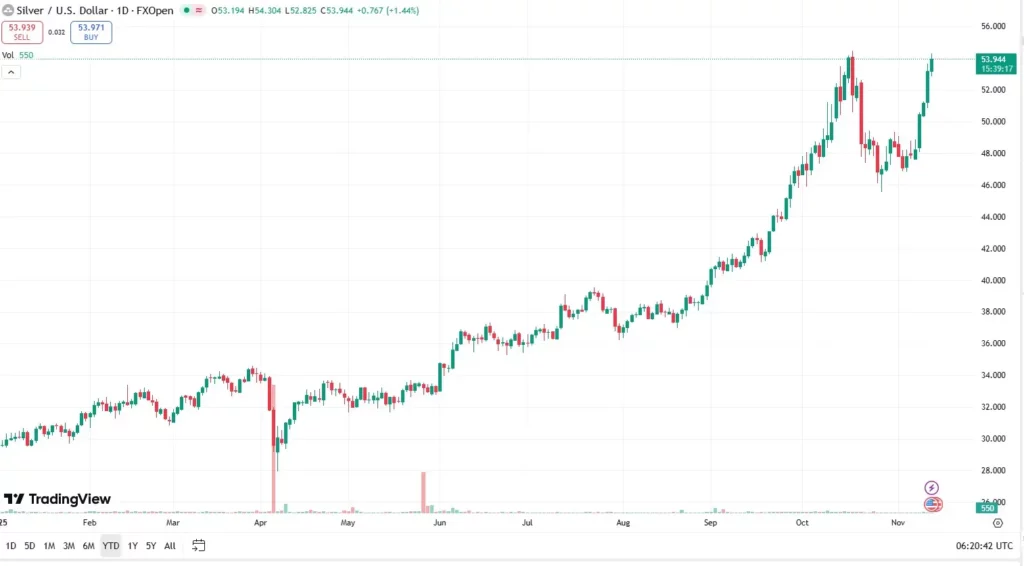
The silver price has shown exceptionally dynamic development in recent months and is now once again at a record high. On the spot market, the price has risen by more than 82% since the beginning of the year! This means silver has clearly outperformed gold this year. However, this movement is not only an expression of speculative flows but also reflects structural supply bottlenecks and strong industrial demand – factors that further amplify fluctuations in the silver price.
Unlike gold, silver is closely linked to the real economy. The metal is widely used in electronics, solar modules, the battery industry, and numerous other applications. This close connection to the economy ensures that silver benefits during periods of economic dynamism but can also fall significantly during downturns. Accordingly, the silver price is considered significantly more volatile than the gold price.
Silver Price and Short Squeeze between London and COMEX
A significant driver of the recent rally is a pronounced scarcity of physical silver, particularly in the London market. A short squeeze has developed there: market participants who bet on falling prices and short-sold futures are forced to close their positions with buybacks due to the unexpected price increase. In a tight market, this further amplifies the upward movement.
This situation has led to an unusual price difference: In London, the price for physical silver is temporarily about $3 per ounce above the COMEX contract quotations in New York. Such a premium is rare for silver, as high transport and storage costs usually limit arbitrage.
Inventories at major trading venues also indicate scarcity. Approximately 500 million ounces of silver were reported in COMEX warehouses in late summer 2025. While this quantity has fluctuated slightly since then, it has not grown significantly overall. Furthermore, a large portion of the inventories is classified as “eligible” – meaning it is allocated to the owner but not automatically available for delivery from futures contracts.
Data from the London Bullion Market Association (LBMA) also indicates declining inventories in the city’s vaults. Collectively, these figures underscore that the market was already tight before the recent price surge – and an additional demand impulse, for example from India or funds, could further exacerbate the situation.
India as a Demand Driver for Physical Silver
India, the world’s largest silver consumer, plays a central role in the current development. Estimates suggest that about 80% of the demand there is covered by imports. This year, silver imports to India have risen significantly; market observers speak of a doubling in the run-up to the Diwali holiday season.
The Diwali festival is traditionally an important period for precious metal purchases. In addition to gold, there is increased demand for silver coins, bars, and jewelry. Furthermore, there is industrial use in electronics and other applications. In an already tight market, this additional demand withdraws physical goods from the West. The result: Premiums of more than 10% on the international spot price are reported in India, a clear sign of high local demand.
In parallel, exchange-traded funds (ETFs) backed by physical silver holdings have absorbed additional quantities. Inflows into such products tie up metal in vaults and reduce the immediately available supply. The combination of ETF demand, higher imports, and already low inventories contributes to keeping the silver price at an elevated level and increasing the risk of abrupt movements.
Gold Price as an Anchor amidst Interest Rates and Geopolitical Tensions
While silver is strongly influenced by industrial use, gold follows a different pattern. Although the recent rise in the gold price is partly related to the same macroeconomic factors as the silver price – such as the expectation of falling interest rates and persistent inflation concerns – a structural shift in significance is also emerging.
Gold is increasingly viewed less as a short-term instrument for hedging against inflation or crises, and more as a permanent component in broadly diversified portfolios. Historically, the precious metal served as the basis of the international monetary system; it lost this function with the end of the gold standard. Current market developments suggest that gold is now increasingly perceived as a neutral store of value that partially decouples from the economy and the cycle of other commodities.
An important factor is ongoing trade conflicts and geopolitical tensions. Tariffs, retaliatory tariffs, and a fragmentation of global supply chains fuel doubts about the stability of individual fiat currencies. In this environment, gold appears to many market participants as a largely politically neutral store of wealth. Added to this is the well-known inverse relationship with interest rates: as yields fall, the opportunity cost of holding gold decreases, which can support demand for the precious metal. Central banks and institutional investors are increasingly considering this correlation in their allocation decisions.
Different Roles of Silver and Gold in a Precious Metal Portfolio
The current rally highlights the different characteristics of silver and gold. Historically, the silver price reacts about two to three times as strongly to economic changes as the gold price. This is due, not least, to the fact that trading on futures markets is dominated by derivatives, and physical bottlenecks, such as those that can occur during a pandemic or due to logistics problems, further influence price formation.
Silver combines the properties of a precious metal with those of an industrial metal. During periods of economic upswing, this dual role can lead to above-average price movements, but during downturns, the same factors can also contribute to disproportionate declines. Gold, on the other hand, is less affected by production and demand fluctuations in individual sectors. Its market profile is strongly oriented towards factors such as inflation and interest rate expectations, currency risks, and geopolitical tensions.
For market observers, this paints a picture of two precious metals with clearly distinct functions: Silver stands more for growth and industrial expectations, while the gold price is more for the pursuit of stability and value preservation. The recent movements in the silver market – from supply scarcity and the short squeeze in London to high demand from India – demonstrate how sensitively the silver price can react to changes in the interplay between the physical market and the financial market.